
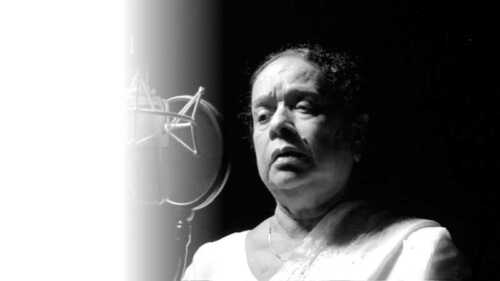
Nanda Malini Pavana and the voice of the unheard
How one singer turned the song into a language of resistance for a wounded Sri Lanka
There are singers whose voices become part of a nation’s entertainment. There are others whose voices become part of its memory. And then there are those rare artists whose voices become part of a nation’s conscience.
Nanda Malini belonged to the third kind. Her death at the age of 82 has left Sri Lanka not merely mourning an extraordinary singer, but listening again to a body of music that has accompanied the country through some of its most painful decades. She was the voice of love and childhood, motherhood and loneliness, devotion and beauty. But she was also the voice of those who had no microphone: the poor, the frightened, the politically silenced, the mothers waiting for children, the young confronting an uncertain future, and ordinary citizens asking why their country had become a place of fear and injustice.

She understood something that modern Sri Lanka repeatedly forgets: a song can become a form of political memory. A lyric can become testimony. And a voice can become a shelter for people who have been denied the right to speak.That is why Nanda Malini’s legacy cannot be contained within the familiar description of her as Sri Lanka’s “Golden Voice.” She was undoubtedly one of the greatest architects of modern Sinhala music, alongside the towering influence of W. D. Amaradeva. But her importance lies also in what happened when that beautiful voice entered the territory of political suffering.
Nowhere is that transformation more powerful than in Pavana. And nowhere is the continuing life of Pavana more revealing than in the 2022 Aragalaya, when a generation born long after those songs were written rediscovered them at Galle Face.The extraordinary irony is that the survival of Nanda Malini’s resistance songs is both a celebration of her artistic power and an indictment of Sri Lanka. If the songs remain relevant, it means that the wounds that produced them have not entirely healed.
A voice born from ordinary hardship
Before she became a national cultural icon, Nanda Malini was a child who knew poverty.
Born on August 23, 1943, she grew up in a large family in modest circumstances. Her father was a tailor. Her early memories were not of privilege but of scarcity, work and family sacrifice. Those experiences mattered because the singer who would later speak for the marginalised had not discovered poverty as an abstract political concept. She had encountered deprivation inside her own home.
One of the most revealing stories from her childhood concerns the prize money she received after winning a singing competition. She had the choice between a foreign trip and money. She chose the money because her family needed it.
She wanted to buy her father an electric iron because she had seen him struggling with an old-fashioned iron. Only later did she realise that the family home did not even have electricity. The money therefore helped bring electricity to the house, and she bought her father a hot-water flask so his tea would not become cold at night. It is a small family story, but it illuminates the moral foundation of the artist.
Nanda Malini never forgot the dignity and humiliation of ordinary economic life. She knew what it meant to stand at someone’s door and be rejected. She knew the anxieties of a household without security. Her later political songs were therefore not simply ideological statements. They were rooted in an emotional knowledge of vulnerability. This distinction is important. She did not sing about “the people” as a distant political category. She sang from within the world of the people.
From the beauty of song to the burden of conscience
Her musical relationship with W. D. Amaradeva opened the way towards an extraordinary career. Her playback singing in Ranmuthu Duwa, Sri Lanka’s first full-length colour Sinhala film, established a remarkable new voice, while songs such as Galana Gangaki Jeevithe demonstrated the emotional and technical range that would define her career.
She would eventually sing for more than a hundred films and become one of the most celebrated voices in the history of Sinhala music. But the conventional biography great singer, great film songs, great awards is not enough.
Nanda Malini continually expanded the boundaries of what a singer could be. She sang devotional songs, children’s songs, love songs, folk-inspired songs, classical compositions, film music, television themes, songs of grief and longing. And then she began singing about power.
Her collaboration with lyricist Prof. Sunil Ariyaratne became particularly significant. Together they created a body of work in which poetry and music became vehicles for confronting social reality. Before Pavana (Gentle Breeze), there was already Sathyaye Geethaya (Songs of Truth) and other work that revealed her movement towards a more explicitly critical musical vocabulary.
The important point is that political consciousness did not suddenly arrive in Nanda Malini’s music in 1987. It had been developing. Pavana was the moment when that consciousness became impossible to ignore.
Pavana, when a song entered the storm
When Pavana emerged in 1987, Sri Lanka was living through one of the darkest periods in its modern history. The country had experienced the devastation of Black July. The war in the North and the East was deepening. In the South, youth alienation and political violence were intensifying. Unemployment, inequality and fear were transforming the emotional landscape of a generation.
The country was not merely politically divided. It was traumatised.Into that atmosphere came Pavana.Its songs spoke about young people, injustice, political violence, imprisonment, death and the dreams of a generation that believed the country had abandoned them.
The songs became controversial. Some were prevented from being broadcast by State media, and the work became associated with the broader political tensions of the period. The political environment surrounding Pavana was so dangerous that Nanda Malini and Sunil Ariyaratne faced threats and eventually spent time outside the country. Historical accounts describe how the songs nevertheless continued to circulate through cassettes and live performances.
That is the first great lesson of Pavana. When institutions attempt to silence a song, they do not necessarily destroy it. Sometimes they teach the song how to travel without them.
A banned song moves from the radio to the cassette. From the cassette to memory. From memory to the human voice. And once a song has entered people’s hearts, it becomes very difficult to censor.
The mother, the missing child and the politics of grief
The deepest power of Nanda Malini’s political songs lies in their refusal to speak about oppression only through political vocabulary.
She humanised the victim. She gave the suffering face of a mother, the fear of a child, the grief of a family. One of the most haunting passages from the Pavana repertoire begins:
Avurudu pandahasak thawa innata
Paramayusha mata athi bawini
Mage podi patawui thepiwath me
Sora muluwen ma galawanu manavi
The appeal is directed towards the young: “My little ones, rescue me…”
The political meaning is enormous precisely because the language is intimate. It is not the language of a political manifesto. It is the language of a parent. The older generation is exhausted. The country has been wounded. The speaker looks towards the young and asks them to rescue what has been damaged.
Decades later, those words would acquire another life. The Pavana songbook became a kind of emotional archive of the violence and anxiety of the late twentieth century. For young people who experienced repression and imprisonment, music could offer something political institutions could not: a sense that their suffering had been witnessed.
This is the extraordinary capacity of resistance music. It tells the oppressed: you are not invisible. Your grief has a name. Your fear has a language. Your experience exists beyond the walls that confine you.
When the prison cell becomes a concert hall
There is something especially powerful in the stories of Pavana songs circulating among imprisoned young people during the years of political violence. Separated by walls and physical confinement, prisoners could still sing. A song could travel where a political message could not.A voice from one cell could reach another. The significance of such moments goes beyond whether one agrees with the politics of the movement associated with them. What matters is the human function of the song.
Music restores connection. When imprisonment attempts to isolate a person, a shared song can say: you are not alone. When censorship attempts to erase an idea, a lyric can preserve it. When fear tells people to remain silent, a collective voice can make courage possible.
This is why resistance songs matter in societies marked by political violence. They do not merely entertain protest movements. They help create the emotional infrastructure through which people recognise one another as citizens.
The uncomfortable side of Pavana
Yet Nanda Malini’s legacy does not require us to pretend that every Pavana lyric is aesthetically perfect. Some of the songs are direct. Some are openly polemical. At moments, political declaration overwhelms metaphor. Compared with the more restrained political poetry associated with artists such as Gunadasa Kapuge and lyricists such as Ratna Sri Wijesinghe, parts of Pavana can feel less subtle.
That criticism deserves recognition. But political art cannot always be judged by the standards of artistic distance. Sometimes history does not give artists the luxury of whispering. There are moments when a poet can suggest.
There are moments when a singer must shout. Sri Lanka in the late 1980s was such a moment. Young people were disappearing. Families were terrified. Political violence had entered everyday life. The distinction between private grief and public catastrophe had collapsed.
Pavana therefore has to be understood not simply as a collection of songs, but as an artistic response to an emergency. Its rough edges are part of its historical character.
Why her voice mattered
But lyrics alone cannot explain Nanda Malini’s political power. It was the voice. Her deep, resonant vocal quality possessed an unusual combination of authority and tenderness. She could sound maternal without becoming sentimental. She could sound angry without losing musical discipline. She could make a quiet line feel heavier than a shouted slogan.
That was politically important. Nanda Malini did not have to imitate the voice of a revolutionary. She remained recognisably herself. The same woman who could sing to a child could sing about a murdered youth. The same voice that could express romantic longing could confront political cruelty.
In doing so, she demonstrated something deeply significant about women’s voices in public life.
She did not have to abandon femininity to become political.She transformed the cultural authority associated with the female singer the mother, daughter, lover, sister into a language of citizenship.
The suffering woman was no longer simply someone to be protected.She was someone who could speak.
Beyond one community
It would also be inadequate to reduce Nanda Malini’s political identity to Sinhala nationalism.
Her career contained contradictions, as any long artistic life does. Yet she also made significant efforts to cross linguistic and cultural boundaries.
Her Kunkuma Pottu work, which incorporated Tamil songs, was commercially unsuccessful and drew criticism. But its very existence represented an important cultural intervention: an attempt by a major Sinhala singer to enter the musical and linguistic world of another community.
Her argument was simple and profound that a deeper knowledge of Tamil language and culture might have helped prevent some of the misunderstandings that contributed to Sri Lanka’s conflict.
This matters enormously today. The politics of resistance should not simply replace one dominant voice with another. The real purpose of resistance is to expand the circle of people whose voices are heard. That is the standard by which Nanda Malini’s legacy should ultimately be judged.
In 2022, Sri Lanka’s economic and political crisis produced another generation of protest.
At Galle Face, young people gathered against corruption, political arrogance, economic collapse and a governing system they believed had failed them. The protest movement was technologically different from the political struggles of the 1980s. Its language travelled through smartphones, hashtags, memes, livestreams and social media.
Yet something astonishing happened. The old songs returned. On April 12, 2022, Nanda Malini joined other senior artists at the Galle Face protest, standing alongside a generation that had grown up in a completely different media environment.
The image was almost symbolic enough to belong in a history book. The cassette generation met the smartphone generation. The woman who had once sung against the political wounds of the 1980s now stood among young people protesting another crisis.
The historical circumstances were not identical. But the emotional question was familiar. What happens when a generation loses faith in those who govern it? What happens when young people inherit a country burdened by the failures of their elders?
What happens when the promise of citizenship is repeatedly betrayed? At Galle Face, Nanda Malini’s old songs acquired new meanings. The “little ones” of the 1980s had become parents and grandparents. The young people listening in 2022 had inherited the unfinished country. And suddenly Pavana was no longer an old record. It was contemporary political memory.
The importance of resistance songs in modern Sri Lanka
This is perhaps where Nanda Malini’s legacy becomes larger than Nanda Malini herself. Modern Sri Lanka needs resistance songs not because every song must become partisan, but because democracy requires spaces in which suffering can be articulated. When people are silenced, music can preserve testimony. When official narratives simplify history, songs can preserve emotional truth.
When communities are divided, music can create unexpected forms of recognition. When young people feel politically powerless, collective singing can transform private frustration into public expression. A resistance song does not necessarily overthrow a government.
Its power is often more fundamental. It prevents people from believing that their suffering is meaningless. It creates a vocabulary for anger. It gives grief a melody. It makes memory portable. And perhaps most importantly, it allows the oppressed to hear themselves as a collective.
This is why authoritarian and insecure political systems have always been uncomfortable with songs. A Government can control a television station.
It can regulate a newspaper. It can block a website. It can intimidate an individual journalist.
But controlling thousands of people singing the same words is much harder.The song becomes a meeting place.
The greatest irony of Pavana
Nanda Malini once expressed an idea that should perhaps be regarded as the ultimate test of her political music: if the conditions that made Pavana necessary disappeared, then the songs themselves should become unnecessary.
That is the paradox. The greatest success of a resistance song is to make itself obsolete. If a song condemns corruption, we should build institutions in which corruption becomes harder. If a song mourns disappeared children, we should create a country where no mother fears that her child will disappear. If a song speaks for unemployed youth, we should build an economy that gives young people dignity. If a song protests political repression, we should create institutions that protect dissent.
If a song asks the young to rescue the country, we should stop placing the burden of rescuing Sri Lanka upon generation after generation of young people. The continuing relevance of Pavana is therefore beautiful and painful – beautiful because the songs survived, painful, because the conditions that produced them have never completely disappeared.
Nanda Malini and the unfinished song of Sri Lanka
Nanda Malini’s artistic universe was much larger than political music. She was also the singer of children, mothers, lovers and devotees. Generations heard her voice through radio, cinema, television, family rooms and school performances.
That breadth is precisely why her political songs became so powerful. When the familiar singer suddenly spoke about injustice, listeners could not easily separate the political voice from the intimate voice they had trusted for decades.
She had already entered people’s emotional lives. Therefore, when she spoke for the oppressed, she was not an outsider arriving with a political message.
She was already inside the nation’s heart. That is the source of her extraordinary authority. Her voice belonged to the country because it had accompanied the country through so many stages of life.
The nightingale has not fallen silent
Nanda Malini’s death comes at a moment when Sri Lanka is still struggling with many of the questions her music raised.
Who speaks for the powerless? Who remembers the disappeared? Who protects the dignity of the poor? Who gives language to the grief of mothers?
Who listens when young people say that the country has failed them? And what does it mean to resist without reproducing the exclusions that resistance itself can sometimes create?
Her songs do not provide easy answers. Perhaps that is why they remain alive. A great singer leaves behind recordings. A great artist leaves behind a tradition. But an artist who becomes part of a people’s conscience leaves behind questions.
Nanda Malini leaves us those questions. She also leaves us her voice. It remains in the old songs. In the children’s songs. In the devotional melodies. In the film music. In the political poetry of Pavana. In the memories of those who heard her live. In the young people who rediscovered her at Galle Face. In every listener who has ever felt that a song somehow understood what they could not say themselves.
And perhaps that is the deepest meaning of her life. She did not simply sing for Sri Lanka.
She helped Sri Lanka hear itself. She gave the country a mirror in music. Sometimes that mirror was beautiful. Sometimes it was unbearable. Sometimes it showed a wounded mother. Sometimes a frightened child. Sometimes an angry young person. Sometimes a country drowning in its own contradictions.
But she never turned away from the reflection. That is why her political songs remain important not because Sri Lanka should live permanently inside the anger of the 1980s, but because every generation needs the courage to recognise injustice when it appears again in a new form.
Resistance songs are not relics. They are warnings. They are archives. They are acts of remembrance. They are emotional citizenship.
And when the powerful attempt to monopolise the definition of reality, the singer can say: No. There is another story. I have heard the people. I will sing what they cannot say. That was Nanda Malini’s extraordinary gift. Her voice became a place where the unheard could briefly become audible.
And that is why the most fitting tribute to her is not simply to call her a great singer. It is to listen to what she was singing about. Then to ask whether we have changed enough to make those songs unnecessary. Because if Pavana still speaks to us, the unfinished work is not hers.
It is ours. The microphone has passed from her generation to ours. The song is still in the air. And Sri Lanka is still being asked to listen.