
Next electricity tariff revision in Sept

- Govt acknowledges indirect economic impact
- Talks to be held on relief for industries
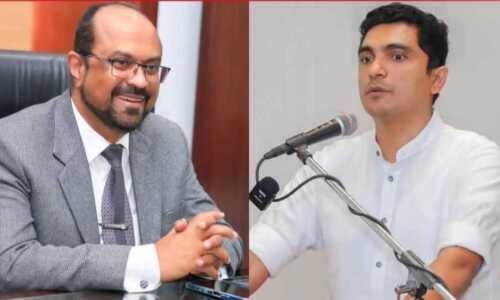
Energy Minister Anura Karunathilaka said the Government will not propose another electricity tariff revision until September of this year (2026), expressing hope that improved rainfall and favourable movements in global fuel prices would help ease pressure on electricity generation costs.
Speaking on the latest electricity tariff revision during a special media briefing yesterday (11), he said that the Government expected an increase in rainfall in the coming months until September, which would support hydropower generation.
He also said there are “positive expectations” regarding fuel prices in the global market, adding that a reduction in fuel prices could provide some relief locally. “As the Energy Ministry, we don’t expect to request another electricity tariff increase until September,” he said.
He also acknowledged that factors such as rising fuel prices and changing weather conditions affect electricity generation costs and utility bills, but stressed that the Government would not pass the full burden onto consumers. “As a Government, we are not going to place the entire burden on consumers or the relevant companies. A portion of that cost will definitely be borne by the Government,” he said.According to him, Sri Lanka currently has 7,913,820 electricity consumers, of whom 6,751,133 are domestic users. Of that number, 6,429,757 consumers use less than 180 units of electricity per month. He said that consumers using below 180 units would not be affected by the latest tariff revision and would not face an increase in electricity charges.
The comments came as the latest 18 per cent increase in electricity tariffs for consumers using more than 180 units came into effect yesterday. The Public Utilities Commission of Sri Lanka (PUCSL) had earlier approved electricity tariff revisions for the second quarter of 2026 with effect from 1 April, increasing tariffs by between eight% and 14.4%. Subsequently, the National System Operator submitted a revised electricity cost estimate to the PUCSL on 27 April seeking a further increase due to rising fuel costs linked to power generation. The Government has also agreed in writing to provide a Rs. 15 billion subsidy to reduce the impact on consumers.
The Government has meanwhile acknowledged that the recent 18% electricity tariff increase for consumers using more than 180 units would have an indirect impact on the wider economy and even on consumers using less than 180 units of electricity.
The Government is also planning to continue discussions on possible relief measures for the affected sectors, particularly the industries.
Karunathilaka said that increases in utility costs eventually affect the entire economy and not just electricity bills alone. “There is an indirect impact across all sectors. In the end, it affects the overall economy. We never deny it,” he said.
He noted that industries such as the apparel and tea sectors would also be affected, adding that increased production costs could eventually influence both export markets and domestic prices.
He admitted that industrial and commercial institutions consuming more than 180 units would experience higher electricity bills and that such businesses would eventually pass those costs onto consumers. “That creates an indirect impact on the public. We are not rejecting that reality,” he said.
However, he stressed that if the entire burden is absorbed solely by the institutions concerned (electricity suppliers), it would become difficult for those entities to continue operations.
He said that the Government had already provided relief to domestic consumers and would discuss what support may be required for industries depending on future developments. “As a Government, we cannot bear the entire burden of these costs. Therefore, one portion is borne by the Government and the remaining portion is passed on to consumers. In the coming days, we will discuss and see what relief measures can be taken regarding the affected sectors,” he said.
0 reacts