
Sri Lanka’s rising black economy and corruption?
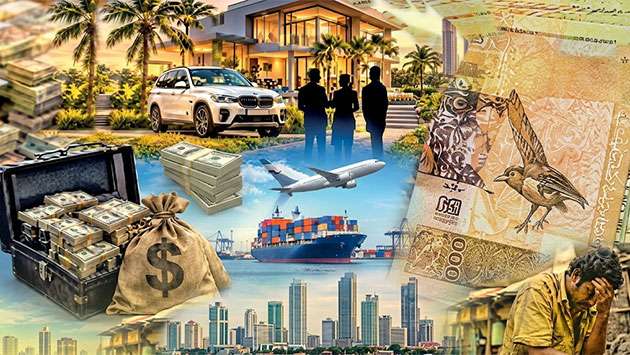
– Sri Lanka is slowly emerging out of its worst economic crisis. As part of the initiatives to stabilise the economy, the government has commenced many programs to combat corruption and the black economy as part of the IMF program. However, some developments in the economy suggest a possible increase in black economy activities and corruption.In 2025, Sri Lanka improved its score in Transparency International’s Corruption Perception Index. The 2025 score of 35 is a marginal improvement after reaching the worst-ever score of 32 in 2024. Nevertheless, recent developments place Sri Lanka at risk of a lower score for 2026.
Historically high cash circulation
A sharp increase in cash circulation is considered a warning sign in rising black economy and corruption. People hoard cash to hedge against institutional unpredictability and because of the need to maintain liquid reserves to easily finance illicit payments. Illegitimate transactions rely heavily on the untrace ability of physical cash over formal banking channels.Sri Lanka’s stock of physical cash (notes) circulation has seen an unusual increase. It was reported that physical cash circulation reached a historic high of Rs 1.7 trillion during the first quarter of 2026. This is a 42 per cent increase from cash circulation reported as at the end of 2023.Sri Lanka’s total volume of digital payments has now surpassed the nominal GDP. This is a very good development compared to the global average of 35 per cent of GDP, and between 40 and 65 per cent of GDP in advanced economies. In such background, why public need large cash stocks is puzzling? The most probable cause of this is the expansion of the underground economy and a possible rise in corrupt practices in the country.
Rise in offshore money transfers
An increase in the money flowing out of the country is also a strong sign of corruption, as illicit funds, bribes, and embezzled public money are usually moved to safer or secret foreign accounts. At the rate illegal foreign payment schemes are being discovered (by law enforcement agencies), we can argue that illegal money transfer schemes have not only increased, but also become entrenched within the formal banking system. Interestingly, most of these illegal money transfer schemes have started or expanded during the last few years.While billions of dollars are channeled out of the country using methods like phantom imports, there is also an increase in Sri Lankan businesses transferring money out of the country as investment.Central Bank data reveals that USD 200 million (net) has been taken out of the country since 2024 (upto first quarter of 2026) as equity investments alone (USD 22.2 million per quarter). This is a sharp increase compared to USD 115 million equity investment outflow reported for the five-year period up to 2023 (USD 5.75 million per quarter).
Growing high-end property market
Sharp increase in luxury property sales is another common indicator of a rising black economy and corruption. Research shows that corruption directly drives up property demand in developing countries by turning real estate into a primary vehicle for laundering illicit funds. Criminals and politically exposed individuals convert dirty money into high-end real estate investments. Moreover, buyers of real estate can use opaque structures like shell companies, trusts, or straw buyers to hide true ownership of real estate.Recent reports show a sharp rise in luxury condominium property transactions. Despite an overall slowdown in condominium sales, demand for “high-end” condominiums has increased according to Central Bank Condominium Surveys. Nearly 52 per cent of condominiums sold during the first quarter of 2026 were high-end apartments, compared to 33 per cent a year ago.Also, there has been a sharp increase in new ultra-high-end property projects, suggesting a growing demand for same. An increase in high-value property sales is also evident from a steady increase in government stamp duty revenue, which has reached Rs 74 billion in 2025.
Further, in 2025 Sri Lanka was ranked as the second most expensive housing market in the world – based on rentals compared to average income. It is possible that market distortions caused by the black economy and corruption have contributed to this.
Likely outcome?
The most likely outcome of an increase in the black economy and corruption is social unrest. This is because an increase in income inequality and rising poverty are associated with rising black economy and corruption. Corrupt systems distribute wealth to elites while regular people struggle with basic needs, high inflation, and joblessness. Already, Sri Lanka is experiencing rising poverty (over 25 per cent), high inflation (over 8 per cent) and extremely high unemployment among educated youth (over 43 per cent).The writer is an Investment, Strategy and Policy Advisory professional. He has a master’s degree in economics (Colombo), an undergraduate degree in Business (Wisconsin, USA), and also obtained CFA charter (USA). He is contactable on indika.h@jupitercapitalpartners.com

Comments – 4
Recommended
 18
You May Also Like
Trending