

Court of Appeal orders action to prevent elephant deaths in train collisions
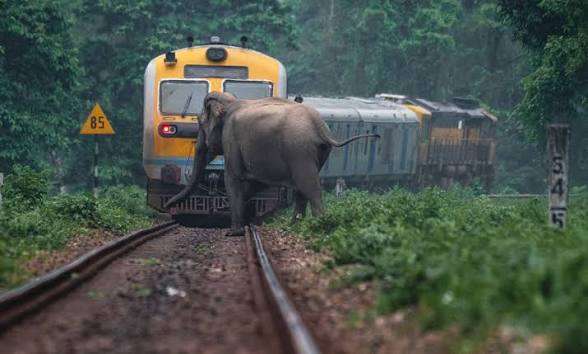
The Court of Appeal has directed State authorities to take measures to prevent wild elephant deaths caused by train collisions, in a landmark environmental ruling that calls for improved wildlife management, safer railway operations and continued judicial oversight.
The judgment was delivered on September 10, 2026, by Court of Appeal Judge Dr D. F. H. Gunawardhana in a public-interest writ application filed following the collision between the Batticaloa–Colombo “Meenagaya” Express and a herd of wild elephants, which killed seven elephants.The Court granted writs of mandamus in CA (Writ) Application No. 318/2025 and issued a series of directions aimed at preventing further wildlife deaths caused by infrastructure and related human activities.The case was one of two connected writ applications, numbered CA (Writ) Applications Nos. 318/2025 and 319/2025, which raised overlapping concerns about wildlife protection, railway safety and the responsibilities of State authorities.The petitioners relied on newspaper reports published in the Daily Mirror and Sunday Times to highlight repeated elephant deaths on railway lines across Sri Lanka, arguing that authorities had failed to take meaningful measures to prevent or mitigate such incidents, which threaten the country’s wild elephant population.
In a significant development in Sri Lankan environmental jurisprudence, the Court also considered the protection of “Elephant X”, a surviving elephant from the collision, who was named as the second petitioner in one of the applications. The elephant was represented by the Centre for Eco-Cultural Studies as its next friend.Drawing on comparative legal developments in Ecuador, India, Argentina and Pakistan concerning the recognition of animals and nature as rights-bearing subjects, the Court held that it was under a duty to protect the second petitioner.Among its directions, the Court ordered the Director-General of Wildlife Conservation to prepare or implement a national plan and an appropriate management plan for National Reserves to address wildlife deaths caused by infrastructure and related human activities. The official was also directed to report to Court on the measures taken.
The General Manager of Sri Lanka Railways was directed to report on training provided to locomotive pilots and guards, including simulator-based training, the regulation of train speeds at identified elephant crossings and other measures adopted to minimise train-elephant collisions.Recognising the need for continued action, the Court directed that the matter be called again after three months to assess progress in implementing its orders.The two connected applications were supported and argued by counsel from Colombo Law Alliance. Dr Asanga Gunawansa, PC, appeared with Swasha Fernando, Chayangi Kannangara and Sayuru Kariyawasam, while Dilshan Jayasuriya appeared with Dushinka Nelson and Anish de Silva. Both teams were instructed by Paul Ratnayeke Associates.
Senior State Counsel Nayomi Kahawita appeared for the respondents.