
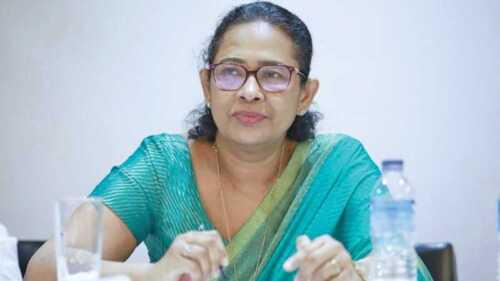
Coal Commission presses ex-Minister on Potentia deal
Pavithra Wanniarachchi struggles to explain how the subcommittee recommended the company on the basis of a lower price
The Coal Commission is now beginning to shed light on a trail of transactions that could reveal how some of the country’s most consequential coal deals were handled. Appointed by President Anura Kumara Dissanayake on April 17, 2026, the Special Presidential Commission of Inquiry is tasked with investigating irregularities in coal purchases and transactions.
The Commission is chaired by Supreme Court Justice Gihan Kulatunga, with Court of Appeal Judge Adithya Patabendige and High Court Judge Sanjeewa Somaratne serving as its other members.Its mandate covers coal transactions from the commencement of operations at the Norochcholai Lakvijaya Coal Power Plant through to April 16, 2026. Proceedings began on April 27 at the Colombo Courts Complex in Aluthkade, opening a formal inquiry into a history of coal procurement that is now coming under close scrutiny.
No coal company at Dubai address
A Dubai address that appears to lead nowhere has emerged as one of the key questions before the Coal Commission which is probing irregularities in the controversial 2024 coal import tender.Former Minister of Power and Energy Pavithradevi Wanniarachchi, who appeared before the Commission last week, was questioned about the company that secured the tender. Although a Dubai address had been listed as the company’s registered address, investigators had established that no such company existed at that location.
Another revelation on the day Wanniarachchi testified was that one of the company’s directors was the son of a person named Beneragama, who had served as a Director at the Ministry of Health and as Deputy Director-General of Health Services. Wanniarachchi herself had also served as Minister of Health.However, when the Commissioners asked whether she knew the relevant details about the company, the former Minister failed to provide a definitive answer.Wanniarachchi was the 71st witness to testify before the Commission. Evidence from earlier witnesses, together with investigations by the Commission’s Investigation Division, has already brought to light a substantial body of information about the company.
Wanniarachchi, who had served as Minister of Power and Energy on two occasions, was appointed Chairperson of a Cabinet Subcommittee on coal imports in 2024, when she was serving as Minister in charge of Wildlife. The other members were then Minister of Energy Kanchana Wijesekera and then Minister of Justice Ali Sabry PC.The Cabinet had tasked the subcommittee with recommending which company should be awarded the 2024 coal import contract. The tender was initially awarded to Aditya Birla Global Trading. However, the controversial company Potentia subsequently sought the contract, offering to import coal at prices lower than those quoted by Aditya Birla.With two companies vying for the contract, the Cabinet sought the subcommittee’s recommendation on which bidder should be selected.
A subcommittee merely to compare figures
Giving evidence before the Special Presidential Commission investigating coal imports and related transactions, former Minister Wanniarachchi said the Cabinet Subcommittee had recommended awarding the tender to Potencia LLC-FZ after considering the country’s financial situation at the time, as the company had offered to supply coal at a lower price.She said the price difference between the two companies’ bids was approximately Rs. 9 billion.
The Commission questioned Wanniarachchi about coal imports during her tenure as Minister of Power and Energy. In response, she said the Ministry Secretary and other officials should be held responsible for the relevant documents. She maintained that her involvement, as the Minister in charge of the subject, had been limited to policy decisions relating to the Ministry.The Commission then questioned her at length about the recommendation to award the tender to Potentia.
Wanniarachchi was unable to provide a definitive answer when asked how the subcommittee had recommended awarding the tender to Potentia on the basis of a letter issued at short notice, even though the company had not been registered as a supplier with the coal company when the tenders were opened. She reiterated that the recommendation had been made because Potentia had offered a lower price.The Commissioners then asked how the subcommittee had obtained information about the lower price before the tender was opened. Wanniarachchi again failed to provide a definitive answer.Amid mounting questions over the tender process, Commission Chairperson Supreme Court Justice Gihan Kulatunga asked whether the subcommittee had merely compared the figures relating to the lower price. Wanniarachchi was unable to provide a satisfactory answer.Justice Kulatunga then questioned why a subcommittee had been necessary if its role had been limited to comparing figures.
A company that appeared out of nowhere
Wanniarachchi was also unable to provide a definitive answer when the Commission asked whether the sudden entry of a company into the process, allegedly in breach of tender procedures and on the strength of an urgent letter from a Minister or another person, or through some other intervention, had been overlooked.Asked whether there had been any suspicion that the process was intended to favour a particular company, Wanniarachchi said she had focused solely on securing coal for the country at a lower price.
She also failed to give a definitive answer when asked whether, in her capacity as Chairperson of the Cabinet Subcommittee, she had questioned then Minister of Energy Kanchana Wijesekera about the matter.The Commission also received no clear answer when it asked whether the Cabinet Subcommittee, comprising three Cabinet Ministers and officials from all relevant institutions, including the Attorney General’s Department, the Ceylon Electricity Board and the Treasury, had been appointed to prepare a comprehensive report on the tender process rather than merely compare prices to identify the lower bid.
A letter for Rakhitha Rajapaksha
Lanka Coal Company General Manager Namal Hewage told the Commission that he had issued a letter to Attorney-at-Law Rakhitha Rajapaksha, son of former Justice Minister Dr. Wijeyadasa Rajapaksha, stating that he had no connection whatsoever with the company.The clarification followed earlier claims that Rajapakshe was the legal adviser to Trident Chemphar Ltd, the company linked to the controversial coal tender transaction.Giving evidence before the Commission, Hewage said he had learnt of a vacancy for the post of Operations Manager at the Lanka Coal Company and submitted an application to the then Chairperson in June 2016.
The Commissioners questioned how he had learnt of the vacancy when no newspaper advertisement had been published. Hewage said a member of the company’s Board of Directors at the time had informed him of the vacancy. He was subsequently appointed Operations Manager, his first position at the company.The post of General Manager was created in 2015, with Palitha Wijegunawardena serving as the company’s first General Manager.Hewage was appointed Acting General Manager and Chief Procurement Officer in December 2020. Since October 2021, he has served as General Manager and Chief Procurement Officer, bringing his tenure at the company to 10 years.The General Manager is the company’s highest-ranking officer after the Chairperson. Hewage also serves as Chief Procurement Officer, the most senior position in the procurement division.
Numerous committee and audit reports on coal imports and related activities have been issued since 2009. The Commission asked Hewage why the bidding documents had been sent to a company in India for advice following a report by Prof. Lakshman R. Watawala.“There were a lot of problems during 2017–2018. We went to South Africa and inspected the sites. We went to see the coal mines as well as the loading port,” he said.His testimony revealed that officials had travelled to South Africa twice at the coal company’s expense.The Commission again asked whether the bidding documents had been sent to India because Sri Lanka lacked individuals or institutions with expertise in coal.Ganga Wakishta Arachchi, representing the Attorney General’s Department, pointed out that Sri Lanka had several institutions and experts with relevant knowledge. These included the Attorney General’s Department, the National Procurement Commission, the University of Moratuwa and the Department of Census and Statistics, as well as experts such as Prof. Lakshman R. Watawala, Renuka de Silva, Saliya Jayasekara, Nammavatta and Amaratunga.
Unusual meetings and differing discounts
The Commission also questioned Hewage about the number of times he had met and held discussions with Sanath Jayasundara of Panaurora (Pvt) Ltd., the local agent of Trident Chemphar Ltd.Ganga Wakishta Arachchi, who conducted the questioning, showed Hewage copies of the Lanka Coal Company’s visitor registers and referred to the dates on which Jayasundara and Indian representatives had visited the company.Hewage acknowledged that Jayasundara had visited the Lanka Coal Company on seven occasions to meet him and other officials. The visits took place on July 16, August 12, August 25, November 9, December 9, December 11 and December 31, 2025.Wakishta Arachchi questioned the appropriateness of the local agent meeting company officials while supplier registration was underway, during the procurement process and even on the day the first ship arrived in Sri Lanka.
Asked whether he had investigated Panaurora’s Board of Directors, Hewage said he had not.A Commissioner also questioned him about a letter issued under his signature to Rakhitha Rajapaksa, son of Wijeyadasa Rajapakshe. Hewage’s failure to respond to some of the questions drew the Commission’s attention.Lanka Coal Company officials are responsible for calculating penalties, delay charges and surcharge adjustments on supplier payments in accordance with the agreements. Hewage was questioned about shortcomings identified in several such calculations.The 213th shipment of imported coal had been rejected, and the supplier subsequently provided the replacement coal in the 221st shipment. However, the delay was calculated as 11 days instead of 39 days when determining the penalty.
A 50 percent discount was also granted on the penalty payable by the supplier. The Commission questioned who had authorised both the calculation based on the shorter delay period and the discount.“The Chairman said that we could reduce it by 50 percent, subject to the approval of senior officials,” Hewage said.p